


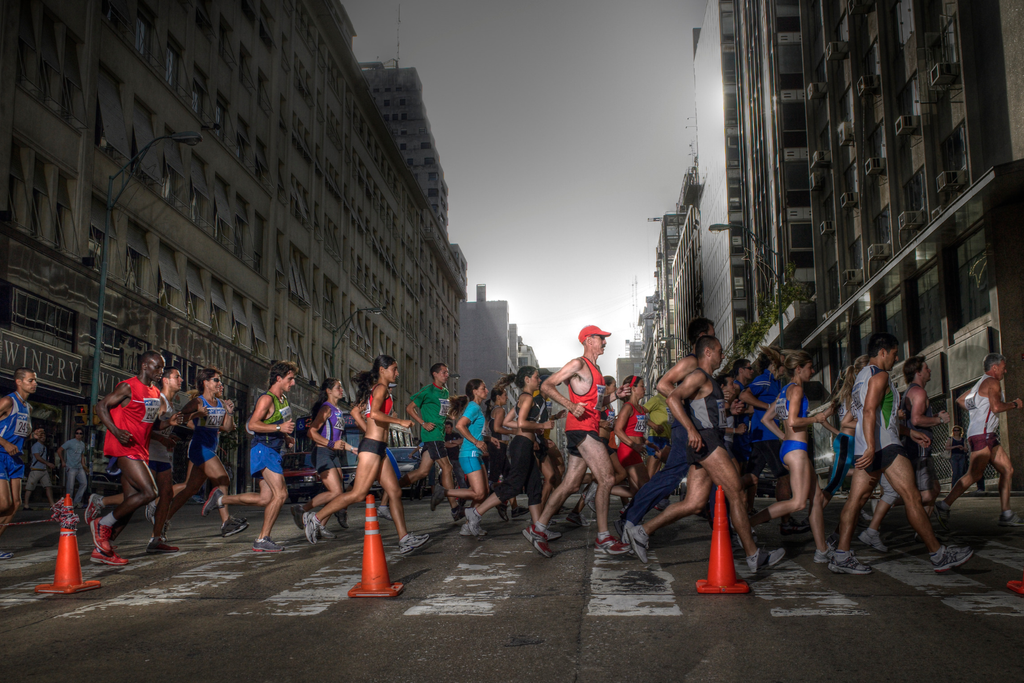
A study of more than 2.7 million marathon performances has found that higher levels of air pollution on race day were associated with significantly slower finishing times, with recreational runners affected more than elite athletes.
The group of researchers at the University of Leicester, funded by the National Institute for Health and Care Research (NIHR) Biomedical Research Centre (BRC) Leicester, analysed 2,756,553 net finishing times from six World Marathon Majors (Berlin, Boston, Chicago, London, New York City, and Tokyo) held between 2010 and 2024.
The team compared finishing times with race-day levels of nitrogen dioxide (NO₂) and fine particulate matter (PM₂.₅), two common air pollutants, using data from the Copernicus Atmosphere Monitoring Service (CAMS).
The research was led by Dr James Donaldson and involved several investigators from the University of Leicester, including Professor Andre Ng, Dr Samuel Cai, and Professor Anna Hansell and was published in Sports Medicine Open in September 2026
Dr James Donaldson, Postdoctoral Researcher in Health and the Environment at the University of Leicester, said: “Nitrogen dioxide is a pollutant mainly produced by road traffic and combustion processes, while fine particulate matter consists of tiny airborne particles that can be generated by vehicle emissions, industry, heating and other sources. Both pollutants have been linked to adverse health effects, particularly on the heart and lungs.
“From our analysis of more than two million marathon runners we observed that levels of nitrogen dioxide were strongly associated with their finishing time. Each microgram per cubic metre (1 µg/m3) increase in nitrogen dioxide was associated with a 1.43 minute slower finishing time in men and 1.56 minute slower finish time in women.”
They also found that the negative effects of nitrogen dioxide were around six times larger for recreational runners than elite runners, and younger runners (18–29 years) showed larger effects than older runners.
The researchers found that the effects of fine particulate matter were not statistically significant.
Dr Donaldson added: “There are many potential explanations for these patterns. Firstly, slower runners remain on the marathon course for longer, so they may accumulate greater pollutant dose during race day. Secondly, the physiological adaptations that result from the high-intensity training undertaken by elite athletes may offer some protection against the harmful effects of air pollution.
“Recreational runners may have less training behind them, so the added strain of pollution during a marathon could have a greater effect on their performance.”
The race-day NO₂ and PM₂.₅ levels in this sample were generally low to moderate relative to the 2021 World Health Organization air quality guideline levels – with most of the marathons falling near or below these thresholds.
From these findings, the Leicester researchers suggest that air quality and event-related traffic policies should be considered alongside temperature and humidity when planning urban endurance events and advising runners, particularly recreational participants who may be most vulnerable to pollution-related performance impairment.
Professor Bryan Williams, Chief Scientific and Medical Officer at the British Heart Foundation which supported the study, said: “This large study suggests air pollution, specifically nitrogen dioxide, has a negative impact on how well people can exercise. While the study is observational and can’t prove cause and effect, it’s not surprising that air pollution could have this effect. We know that breathing in polluted air can trigger inflammation, damage blood vessels, and affect breathing.
“Despite the known harms of air pollution, it is important to note that levels of nitrogen dioxide and PM2.5 on marathon day in London appear to have fallen substantially since the 2010 event, which a great news for heart health. As well as this, the fact remains that exercise is still very beneficial for your cardiovascular health – it can reduce the risk of heart and circulatory diseases by up to 35 per cent. While interesting, the findings of this study definitely shouldn’t put people off running.”
The findings may also have implications beyond marathon running, highlighting how air quality could influence the experience and performance of anyone taking part in outdoor physical activity. Researchers at the University of Leicester are also developing the P-STEP app (Personalised Space Technology Exercise Platform), with support from the European Space Agency.
The P-STEP app uses real-time, location-specific air quality information to help people plan when and where to exercise outdoors while reducing their exposure to pollution.
Dr Samuel Cai, Professor Anna Hansell and Professor Tom Yates are investigators within the British Heart Foundation (BHF) Leicester Centre of Research Excellence, which is led by Director Professor André Ng MBE.
The BHF Leicester Centre of Research Excellence is a major British Heart Foundation investment supporting world-leading cardiovascular research in Leicester. Led by Professor André Ng, the Centre brings together experts in discovery science, clinical intervention and population health research to improve the prevention, diagnosis and treatment of cardiovascular disease while developing the next generation of research leaders.
The NIHR BRC Leicester is part of the National Institute for Health and Care Research and is hosted by the University Hospitals of Leicester NHS Trust, in partnership with the University of Leicester, Loughborough University and University Hospitals of Northamptonshire NHS Group.
The centre brings together world‑leading investigators, clinicians, and research facilities to drive innovation in prevention, diagnosis and treatment of major health conditions.